Best Greek Yogurt at the Grocery Store (2026)
- Out of 172 Greek yogurts evaluated, 135 were disqualified for thickeners or artificial sweeteners — only 37 made the cut.
- Look for 15g+ protein per serving, zero added sugar, and an ingredient list of just milk and cultures.
- Real Greek yogurt and skyr get their thickness from straining, not from corn starch, pectin, or gelatin.
- All five top picks are plain — flavor it yourself with berries, honey, or nuts for far less sugar than pre-flavored cups.
Last updated: February 2026
Quick Summary
We pulled nutrition data for 172 Greek yogurt and skyr products from the USDA FoodData Central database, evaluated them against our criteria for protein, added sugar, and ingredient simplicity, and ranked every product by protein density per 150g. After disqualifying 135 products for thickeners or artificial sweeteners, 37 made the cut. Our top pick is Icelandic Provisions Plain Thick & Creamy Skyr — 17.6g of protein per 150g, just 3.5g of sugar, and a single ingredient.
How We Ranked
We searched the USDA FoodData Central branded food database for "greek yogurt" and "skyr" across 40+ brands available in US retail stores — from national brands like Chobani and Danone to store brands like Kroger, Lowe's, and Great Value. Every product was evaluated against three weighted criteria:
| Criterion | Excellent | Good | Red Flag | Weight |
|---|---|---|---|---|
| Protein per serving | ≥ 15g | ≥ 12g | ≤ 10g | 2.0x |
| Added sugar | 0g | ≤ 6g | ≥ 10g | 1.5x |
| Ingredient count | ≤ 3 | ≤ 5 | ≥ 10 | 1.0x |
Products that tied on the weighted score were ranked by protein density per 150g (higher is better), then by sugar per 150g (lower is better). This ensures fair comparison across different serving sizes — a 1-cup serving naturally shows more protein than a 5.3 oz cup, but that doesn't make it a better yogurt.
Automatic disqualifiers (product excluded regardless of score): - Artificial sweeteners (sucralose, aspartame, acesulfame-K, saccharin) - Thickeners as primary method (corn starch, modified food starch, gelatin, pectin)
By the numbers: - 391 products returned from USDA FDC search - 172 matched brands available in US retail stores - 135 disqualified (most for thickeners, some for artificial sweeteners) - 37 qualified, all plain or minimally flavored varieties
A note on added sugar: The USDA FDC database does not consistently report added sugar for yogurt products. For plain yogurt this doesn't matter — all sugar is naturally occurring lactose. For flavored varieties, we used total sugar as a proxy.
A note on fat: We intentionally did not use fat content as a ranking criterion. Fat in yogurt is not inherently bad — full-fat yogurt improves satiety, helps absorb fat-soluble vitamins (A, D, E, K), and research increasingly suggests that dairy fat in moderation is not the cardiovascular risk it was once thought to be. Our top picks span nonfat, low-fat, and whole-milk options. For each pick, we list both total fat and saturated fat so you can make an informed choice. If you're watching saturated fat, the American Heart Association recommends limiting intake to about 13g per day on a 2,000-calorie diet — a serving of whole-milk yogurt with 4-6g of saturated fat is roughly a third of that daily budget, which is perfectly reasonable if the rest of your meals are balanced.
Our Top Picks
Best Overall: Icelandic Provisions Plain Thick & Creamy Skyr
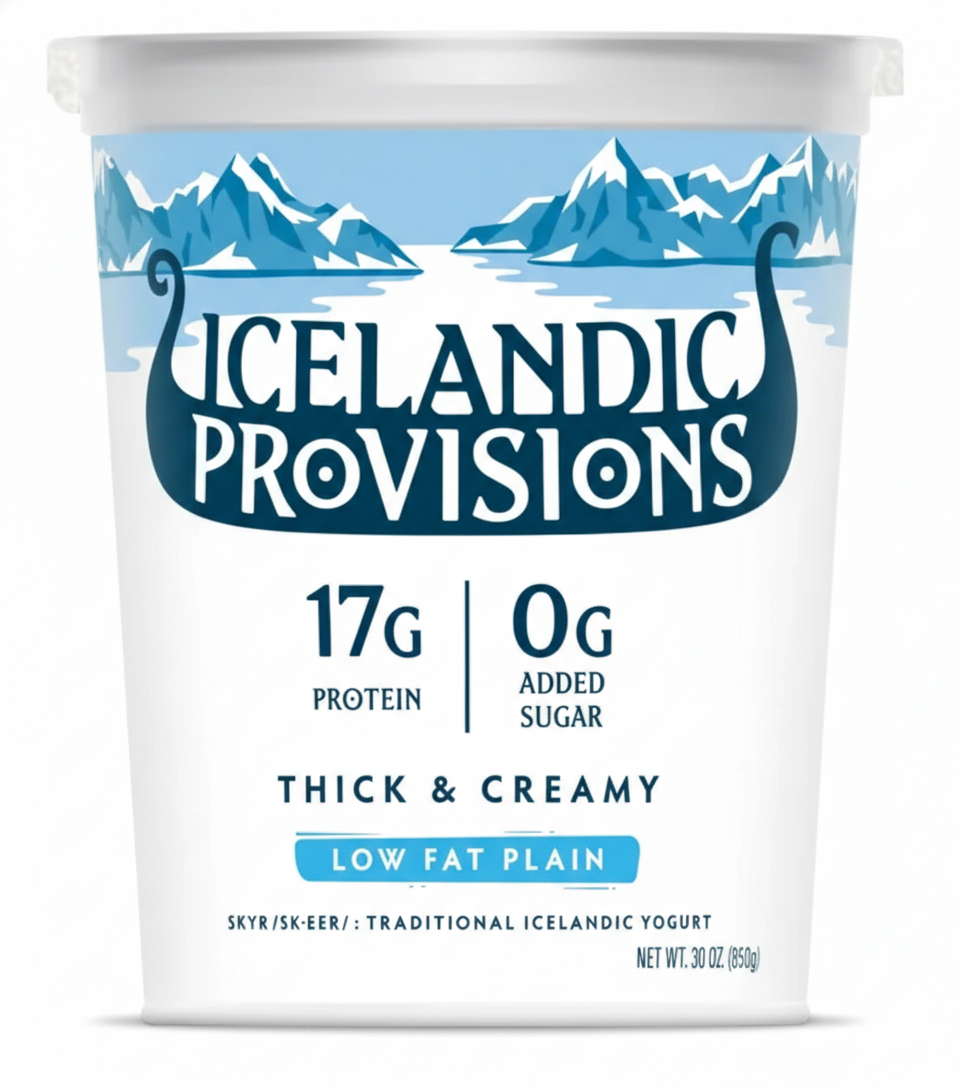
| Nutrition per 3/4 cup (170g) | |
|---|---|
| Calories | 139 |
| Protein | 20g |
| Total Sugar | 4g |
| Total Fat | 2.5g |
| Saturated Fat | 1.5g |
| Sodium | 65mg |
| Protein per 150g | 17.6g |
Ingredients: Skyr (Pasteurized Lowfat Milk, Live and Active Cultures).
Why it's our top pick: The highest protein density in our entire dataset — 17.6g per 150g, which means more protein per spoonful than any other yogurt we tested. It's a single-ingredient product (skyr made from low-fat milk and cultures), with just 3.5g of sugar per 150g. The "thick & creamy" texture comes from traditional Icelandic triple-straining, not thickeners. The low-fat base gives you 2.5g of fat per serving — enough for a satisfying texture without much saturated fat (1.5g). Available at Whole Foods, Target, and many conventional grocery stores.
USDA FDC data. Brand owner: Icelandic Provisions, Inc.
Best Value: Kroger Greek Nonfat Yogurt, Plain

| Nutrition per 5.3 oz (150g) | |
|---|---|
| Calories | 90 |
| Protein | 15g |
| Total Sugar | 6g |
| Total Fat | 0g |
| Saturated Fat | 0g |
| Sodium | 55mg |
| Protein per 150g | 15.0g |
Ingredients: Cultured Nonfat Milk. Active Cultures with L. Acidophilus, B. Bifidum and L. Casei.
Why we recommend it: Excellent nutrition at store-brand pricing — typically $3-4 for a 32 oz tub versus $6-7 for the equivalent amount of a premium brand. Three ingredients (milk, plus two named culture additions beyond the base), 15g of protein, zero fat, and nothing artificial. Kroger also names three specific culture strains on the label, which is more transparency than many name brands offer. If you shop at Kroger, Fred Meyer, Ralphs, or any Kroger-owned chain, this is the best protein per dollar in the yogurt aisle. Lowe's Foods store brand showed nearly identical nutrition (15g protein, 1 ingredient) if that's your local store.
USDA FDC data. Brand owner: The Kroger Co.
Best for Ingredient Purists: Siggi's Plain Nonfat Skyr
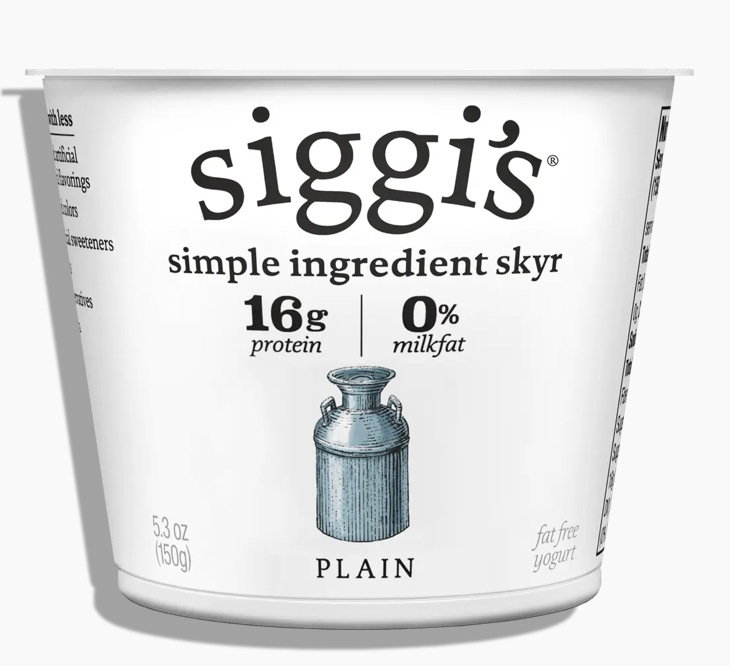
| Nutrition per 5.3 oz (150g) | |
|---|---|
| Calories | 90 |
| Protein | 16g |
| Total Sugar | 4g |
| Total Fat | 0g |
| Saturated Fat | 0g |
| Sodium | 55mg |
| Protein per 150g | 16.0g |
Ingredients: Cultured Pasteurized Skim Milk. Live Active Cultures: S. thermophilus, L. bulgaricus, Bifidobacterium, L. acidophilus, L. paracasei.
Why we recommend it: Siggi's was founded specifically as a reaction to the over-sugared, over-processed American yogurt market — and it shows. One ingredient, five individually named culture strains listed on the label, and the lowest sugar of any 5.3 oz cup in our dataset (4g, all naturally occurring lactose). In our ranking, Siggi's nonfat placed #6 overall with 16g protein per 150g — just behind Icelandic Provisions' thicker formulation. The brand also has a strong track record with their flavored lines: Siggi's flavored varieties use less sugar than almost any competitor. If ingredient transparency and simplicity are your top priorities, Siggi's lives the philosophy more consistently than any other brand. Available at most major grocery chains including Whole Foods, Target, Kroger, and Publix.
USDA FDC data. Brand owner: siggi's.
Best Widely Available: Chobani Plain Nonfat
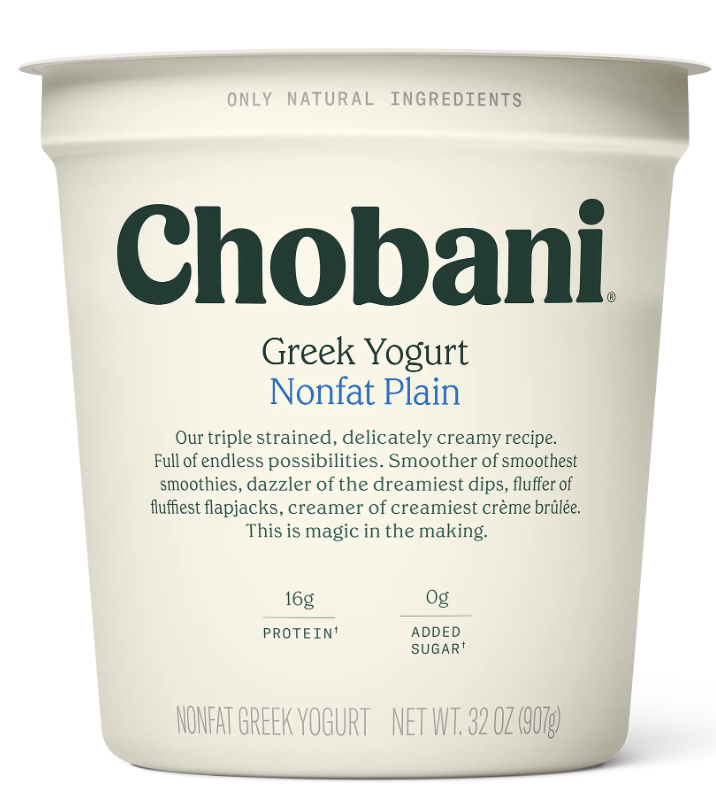
| Nutrition per 5.3 oz (150g) | |
|---|---|
| Calories | 80 |
| Protein | 15g |
| Total Sugar | 4g |
| Total Fat | 0g |
| Saturated Fat | 0g |
| Sodium | 55mg |
| Protein per 150g | 15.0g |
Ingredients: Nonfat Yogurt (Cultured Pasteurized Nonfat Milk).
Why we recommend it: Chobani is the most widely distributed Greek yogurt brand in the US — available at Walmart, Target, Costco, Kroger, Publix, Safeway, convenience stores, and airports. The plain nonfat has excellent numbers: 15g protein, 4g sugar, and just one ingredient (nonfat yogurt made from cultured milk). At 80 calories per 5.3 oz cup, it's the lowest-calorie option among our picks. Ranked #13 overall — it trails the Icelandic skyr brands on protein density, but the difference is small (15g vs 17.6g per 150g), and Chobani's unmatched availability makes it the practical everyday choice. If you're traveling or shopping at a smaller store with limited selection, Chobani plain is the safe bet.
USDA FDC data. Brand owner: Chobani, Inc.
Best Organic: Stonyfield Organic Greek Plain
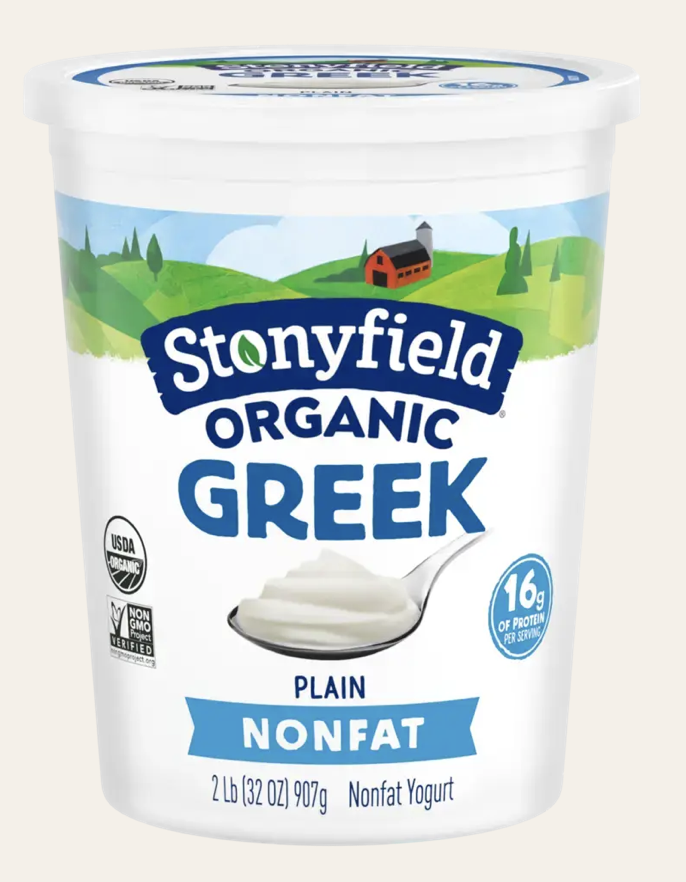
Note: Only Stonyfield's flavored blueberry variant appeared in the USDA FDC database, and it was disqualified for containing pectin and carob bean gum (thickeners). Their plain organic yogurt is widely reported to contain just organic cultured pasteurized nonfat milk — which would easily qualify under our criteria. We include this recommendation based on Stonyfield's published product information but could not verify it through our FDC dataset.
| Reported Nutrition per 5.3 oz (150g) | |
|---|---|
| Calories | 90 |
| Protein | 15g |
| Total Sugar | 5g |
| Total Fat | 0g |
| Saturated Fat | 0g |
| Sodium | 60mg |
Ingredients (reported): Organic Cultured Pasteurized Nonfat Milk, Live Active Cultures.
Why we recommend it: If organic sourcing matters to you, Stonyfield is the established choice — USDA-certified organic means no synthetic pesticides, antibiotics, or growth hormones in the milk supply. Protein (15g) and sugar (5g) are competitive with our other picks. The premium is in the price, not the nutrition — you're paying for the organic certification. Available at most major grocery chains and Whole Foods.
Note: Nutrition data from Stonyfield product information, not verified through USDA FDC.
Honorable Mentions

Siggi's Plain Nonfat Skyr, 5.3 oz (different FDC entry) — A separate FDC entry for what appears to be a Siggi's reformulation or size variant showed 17g protein and just 3g sugar per 150g — ranking #2 overall. If you see this on the shelf, it's arguably the single best cup of yogurt in the dataset.

Oikos Plain Nonfat Greek Yogurt (Danone) — 22g protein per 1-cup serving (14.7g per 150g), just "Cultured Grade A Non Fat Milk." The highest absolute protein count, though its larger serving size (225g) means the density trails the skyr brands.

Oikos Plain Full-Fat Greek Yogurt (Danone) — 20g protein per cup, 9g fat (6g saturated), also just "Cultured Grade A Milk." For those who prefer full-fat for satiety or cooking. The 6g saturated fat per cup is about 46% of the AHA's recommended daily limit — meaningful but manageable if you balance it across the rest of your meals.

Lowe's Foods Greek Nonfat Yogurt — 15g protein per 150g, 1 ingredient, scored 9.0. A strong store-brand option if Lowe's is your local grocery chain.

FAGE Total — One of the most respected Greek yogurt brands, but only a single flavored product (blueberry) appeared in the USDA FDC database. FAGE's plain varieties are widely reported to have 15-20g protein with 2-3 ingredients. We couldn't verify it through our dataset, but it consistently ranks highly in independent testing.
What to Avoid
Based on our analysis of 135 disqualified products:
Thickener-Heavy Yogurts (most disqualifications)
Why: The vast majority of disqualified products contained corn starch, modified food starch, pectin, gelatin, or carob bean gum. These thickeners are used to cheaply mimic the thick texture of properly strained yogurt. Real Greek yogurt and skyr get their thickness from straining — concentrating the protein naturally. Thickened yogurts often have lower protein because they skip or shorten the straining process.
What to look for: Scan the ingredient list for starch, pectin, gelatin, or gum. If you see them in the first five ingredients, the product is likely thickened rather than strained.
Artificial Sweetener Versions
Why: Several brands (especially Danone/Oikos Light and Dannon Light + Fit lines) use sucralose and acesulfame potassium to hit low sugar or low calorie targets. While protein counts can be good (12-15g), we exclude these from our standard recommendations. This is a personal choice — if you specifically want artificial sweeteners, those products exist — but they shouldn't be the default.
Low-Protein "Greek" Yogurts
Why: Some products marketed as Greek yogurt deliver under 10g of protein per serving — that's regular yogurt territory. Real straining should concentrate protein to at least 12g. If the number is low, it likely wasn't properly strained or was diluted.
Quick Shopping Checklist
- [ ] Flip the container — check protein is ≥ 12g per serving (look for 15g+)
- [ ] For plain yogurt, sugar should be all naturally occurring (no "added sugars" on the label)
- [ ] For flavored yogurt, check the added sugars line — under 6g is good, over 10g is a red flag
- [ ] Scan the ingredient list — for plain, it should be milk + cultures, that's it
- [ ] Watch for corn starch, modified food starch, pectin, gelatin — signs of thickening, not straining
- [ ] Avoid sucralose, aspartame, acesulfame-K unless you specifically want artificial sweeteners
- [ ] Don't fear fat — check saturated fat instead, and consider it in the context of your whole day
Plain Yogurt Too Tart? How to Flavor It Yourself
All five of our top picks are plain yogurts — and for good reason. Flavored versions almost universally add thickeners, sugar, or both. But if plain is too tart for you, flavor it yourself:
- Fresh or frozen berries — natural sweetness plus fiber and antioxidants
- A drizzle of honey (1 tsp = ~6g sugar) — far less than manufacturers add to flavored cups
- Cinnamon or vanilla extract — zero-calorie flavor
- Chopped nuts or seeds — adds healthy fats, fiber, and crunch
- A spoonful of nut butter — protein + healthy fat for staying power
You'll use a fraction of the sugar that comes in pre-flavored cups, and you control exactly what goes in.
How This Fits Into a Healthy Meal
Greek yogurt is a protein powerhouse but not a complete meal on its own — it's low in fiber and complex carbs. Pair it with whole grain granola, berries, and a handful of nuts for a balanced breakfast that scores well on blood sugar stability, sodium balance, and nutrient quality. Try scoring your yogurt bowl using our recipe calculator to see how different toppings affect the overall health score.
The Bottom Line
| Pick | Pro/150g | Sugar/150g | Fat | Ingredients | Best For |
|---|---|---|---|---|---|
| Icelandic Provisions Thick & Creamy | 17.6g | 3.5g | 2.5g | 1 | Overall quality |
| Kroger Nonfat Plain | 15.0g | 6.0g | 0g | 3 | Budget shoppers |
| Siggi's Nonfat Skyr | 16.0g | 4.0g | 0g | 1 | Ingredient transparency |
| Chobani Nonfat Plain | 15.0g | 4.0g | 0g | 1 | Widest availability |
| Stonyfield Organic Plain | 15.0g | 5.0g | 0g | 2 | Organic priority |
All picks hit "excellent" on protein (≥ 15g) and have zero added sugar. The differences come down to protein density, price, availability, and whether organic certification matters to you.
Methodology
This guide was produced using data from the USDA FoodData Central Branded Food database. We searched for "greek yogurt" and "skyr," filtered results to 40+ brands available in major US retail stores (Walmart, Target, Kroger, Costco, Whole Foods, Publix, Safeway, Lowe's, Trader Joe's, and others), then evaluated each product against the criteria table above. Products were scored using a weighted system (protein 2x, added sugar 1.5x, ingredient count 1x), with ties broken by protein density per 150g and then sugar per 150g. Products containing artificial sweeteners or thickeners were automatically disqualified. Nutrition values are per manufacturer-stated serving size from FDA-submitted label data. Formulations may change — always verify the label at the store.
Data source: USDA FoodData Central (fdc.nal.usda.gov). Accessed February 2026.